
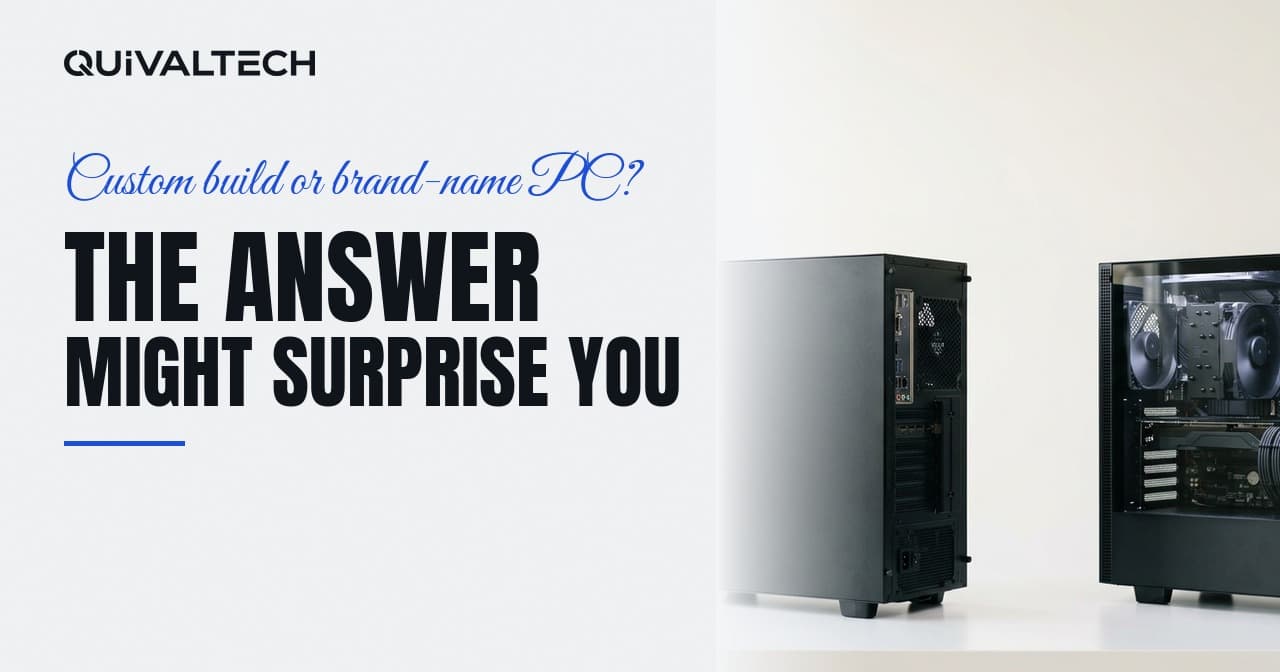
The internet answer is "always build your own." The showroom answer is "always buy ours." Both are selling something. The useful answer depends on you, and it's worth going through properly.
What a prebuilt genuinely gives you
One place to go when something breaks. This is the real value and it's routinely dismissed. With a single warranty covering the whole machine, you don't have to work out whether the fault is the memory, the board or the power supply — that's the manufacturer's problem.
It works today. No research phase, no compatibility checking, no waiting for parts, no assembly.
Tested as a unit. A competent manufacturer has verified that this combination works together, is stable, and stays within thermal limits.
Predictable price. No surprises mid-project because a component moved.
These are genuine advantages, and for plenty of people they're worth paying for.
What a custom build gives you
Every part chosen deliberately. No cost hidden in the parts nobody advertises — the power supply, the board, the case.
Better value at the same price, usually. Not always, and less than it used to be, but generally you get more performance per dollar because you're not paying for assembly and warranty administration.
A clear upgrade path. A board with spare memory slots and M.2 sockets, and a power supply with headroom, makes the next upgrade cost a fraction.
You know exactly what's inside. Which matters later, when you want to sell, upgrade or diagnose it.
Where prebuilts usually cut cost
If you're comparing, this is where to look — these are the parts buyers rarely check and manufacturers know it:
None of these appear in the headline. All of them affect what the machine does.
How to compare a specific pair, fairly
1. Get the full parts list for the prebuilt, with model numbers for every component including the power supply and the case.
2. Price the same parts individually, or as close as you can match.
3. Add the difference up honestly. If the prebuilt is $150 more, ask what that buys: a unified warranty, assembly, no time spent, and no risk of getting it wrong.
4. **Check what's *not* matched.** A prebuilt with a weaker power supply and board isn't the same machine at a lower price — it's a different machine.
5. Include your own time, at whatever you think it's worth.
Sometimes the prebuilt wins that comparison outright, particularly when a manufacturer is clearing stock. Sometimes it loses badly. The only way to know is the specific comparison.
Who should buy which
A prebuilt makes sense if you want it working this week, you value a single warranty contact, you don't want to diagnose hardware yourself, or a good deal is in front of you right now.
A custom build makes sense if you want specific parts, you're planning to upgrade over time, you're optimising value per dollar, or you want a machine built around a particular use.
And there's a third option people forget: have someone local build it to your specification. You get the component control of a custom build without doing the assembly, and a human being nearby who is accountable for it.
What we do
We build to order in Thousand Oaks: you approve the parts list before anything is bought, we assemble and test it, and we benchmark it in front of you so you can see what you're getting. Pickup locally.
We're also genuinely happy to look at a prebuilt you're considering. Send us the parts list and we'll go through it line by line — including telling you when it's a good deal and you should just buy it. That happens more often than you'd think, and we'd rather be the people who told you the truth.